Annapurna Base Camp Trek Cost and Permits
What the Annapurna Base Camp trek costs in 2026: budget, standard and private prices, the ACAP permit, guide, porter, food and lodging costs, and what guided packages leave out.
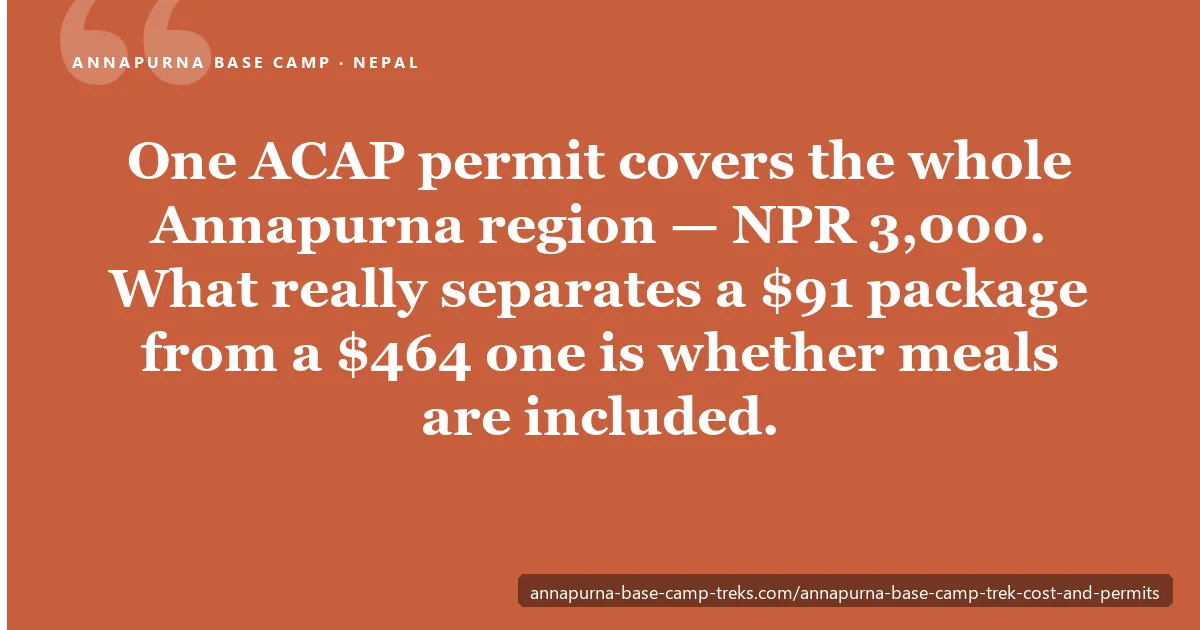
The advertised price of an Annapurna Base Camp trek and the money that leaves your account are two different numbers, and the gap is almost entirely food. A $91 package and a $464 package can both be honest — one includes meals and one does not — so the useful exercise is not comparing headline prices but adding up the same list of items for each.
Add up the whole trip and a guided trek from Pokhara typically costs around US$600–$1,300 per person across the wider market. A short budget package can come in under US$600, and a private trek with a porter, better transport and more inclusions can pass US$1,500. The packages on this site list lower base prices, from $91 to $464, because most leave meals and a porter to you; the worked example further down adds those back in.
There is no single correct Annapurna Base Camp trek cost, because two trips with the same destination can include very different things. A cheap 5- or 6-day package may include little more than a guide, basic accommodation and transport. A more expensive package may include all meals, permits, porter service, private transfers, equipment rental and extra nights in Pokhara.
The most useful question is therefore not “How much is the trek?” but what exactly is included for that price? This guide breaks down the main costs, explains realistic budget levels and shows what to check before booking.
Check Availability
Annapurna Base Camp Trek Cost at a Glance
For a typical trek starting and ending around Pokhara, these are all-in planning ranges from the wider market, not package prices from this site:
| Trek style | Approximate cost per person | What to expect |
|---|---|---|
| Budget | US$500–$750 | Shorter itinerary, basic lodges, shared/group arrangements, fewer inclusions |
| Standard | US$750–$1,100 | Licensed guide, accommodation, transport, often meals and porter/shared porter |
| Private/comfort | US$1,100–$1,500+ | Private guide, porter, private transport, more inclusions and greater flexibility |
| Longer Poon Hill + ABC trek | Often higher | More trekking days, accommodation and meals |
These are planning ranges, not fixed prices. The exact cost depends on the operator, season, route and what is included.
Best way to compare prices: calculate the cost per trekking day, then check whether meals, permits, transport and porter service are included. A US$650 package can cost more in practice than an US$850 package if you have to pay most trail expenses separately.
What Determines the Cost of the ABC Trek?
The biggest factors are:
- number of days
- private vs group trek
- guide service
- porter service
- meals included or excluded
- road transport
- permits and TIMS arrangements
- quality of accommodation
- equipment rental
- extra nights in Pokhara or Kathmandu
The destination is the same, but the travel style can be completely different.
How Much Does a 5-Day Annapurna Base Camp Trek Cost?
A 5-day ABC trek is usually one of the cheaper package options because road transport is used to shorten the lower route.
Budget packages elsewhere can sometimes be found from roughly US$450–$650, while more inclusive private versions may cost considerably more. On this site, the Kathmandu/Pokhara: 5-Day Annapurna Base Camp (ABC) Trek is listed from $91 and rated 4.96 from 161 reviews on GetYourGuide. Meals are an add-on, so the all-in figure sits well above the headline price. The Pokhara: 5-Day Annapurna Base Camp (ABC) Trek via Jhinu runs from $216 and is rated 5.0, though from only 11 reviews so far.
The main issue with a very short itinerary is not only price.
Five days is a compressed schedule for a trek reaching 4,130 metres, so check:
- where the walking starts
- where you sleep each night
- how quickly altitude is gained
- whether the final approach is rushed
- whether meals are included
Do not choose the shortest itinerary purely because it is cheapest.
How Much Does a 7-Day ABC Trek Cost?
For many travellers, a 6- or 7-day itinerary offers a good compromise between time and cost.
A realistic planning range is roughly:
US$600–$1,000 per person
depending on inclusions.
At the lower end, expect basic accommodation and fewer extras.
At the higher end, packages are more likely to include:
- guide
- porter or shared porter
- meals
- permits
- private or upgraded transport
- equipment support
A 7-day trek is one of the most commercially common ways to reach ABC from Pokhara. The Pokhara: 7-Day Annapurna Base Camp Trek on this site is listed from $205 and rated 4.87 from 59 reviews on GetYourGuide. It includes private transport and lodges but no food.
How Much Does a 10-Day ABC Trek Cost?
A 9- or 10-day itinerary generally costs more because you pay for extra:
- guide days
- porter days
- lodge nights
- meals
- transport logistics
However, the longer version may provide better value if it includes Poon Hill, Ghandruk or additional village trekking.
A typical range may be roughly US$800–$1,300+, with private packages going higher.
On this site, the From Pokhara: 10-Day Poon Hill and Annapurna Base Camp Trek is listed from $262 and the Pokhara: 9-Day Annapurna Base Camp Trek with Poon Hill from $464. Both are rated 5.0 from 8 reviews, a small sample so far.
Annapurna Base Camp Trek Cost Breakdown
The total can be divided into seven main categories:
- permits
- guide
- porter
- accommodation
- food
- transport
- personal extras
Let’s look at each one.
The permit: one document, NPR 3,000
The Annapurna region runs on a single permit — the Annapurna Conservation Area Project (ACAP) permit. In 2026 it costs NPR 3,000 for foreign nationals, roughly US$22–25, and NPR 1,000 for SAARC nationals. Children under 10 are exempt. The same permit covers Annapurna Base Camp, Poon Hill, Mardi Himal and the Annapurna Circuit — there is no separate ABC permit.
The TIMS card is the source of most of the confusion online. A great many older blog posts list it as compulsory; it is reported to no longer be checked at Annapurna checkpoints in 2026, though agencies often still issue a group TIMS as a matter of routine. Either way, this is not a decision you make: every guided package on this site includes the permit and the paperwork, arranged before you start walking.
Annapurna Conservation Area fees
ABC lies inside the Annapurna Conservation Area. Current Nepal Tourism Board park-entry information lists the fee at:
- NPR 3,000 for foreign visitors
- NPR 1,000 for SAARC nationals
- NPR 100 for Nepali visitors
- free entry for children under 10
These fees can change, so confirm them before your trek.
TIMS cost
Current Nepal Tourism Board information lists TIMS at:
- NPR 2,000 for most international trekkers
- NPR 1,000 for SAARC-country trekkers
TIMS and guide requirements depend on the exact route under Nepal’s revised trekking rules.
Nepal Tourism Board specifically lists Poon Hill–ABC among the routes covered by its guide-and-TIMS provision.
If your itinerary is a direct ABC route instead of a Poon Hill–ABC combination, ask your registered trekking agency to confirm exactly which paperwork applies. This is where the official listing and the reports from checkpoints disagree, as noted above.
Permit budget
For planning, many travellers should therefore allow roughly:
NPR 3,000 for ACAP + applicable TIMS charges
Do not rely on old blog posts showing lower permit fees.
The guide requirement is now a rule, not an upgrade
Since 1 April 2023 the Nepal Tourism Board has required foreign trekkers to be accompanied by a licensed guide, registered with the Trekking Agencies Association of Nepal. Unaccompanied independent trekking in the conservation areas ended with that decision, and checkpoints verify guide credentials.
This changes the cost arithmetic from a few years ago. “Doing it yourself for the price of a permit and some dal bhat” is no longer an option, which is why the entry-level guided packages have become the practical floor for the trek rather than the premium tier.
Guide Cost for Annapurna Base Camp
A licensed trekking guide commonly costs roughly US$30–$40 per day in the current market, although rates vary by agency, guide experience and what the fee covers.
For a 7-day trek, that can mean approximately:
US$210–$280 for guide service
before considering how the cost is divided between group members. On the packages listed on this site the guide is already inside the price.
Does the guide price include the guide’s food and lodging?
Often, an agency’s quoted guide rate covers the guide’s wage and trail expenses.
But do not assume this.
Ask whether you are expected to pay separately for:
- guide meals
- guide accommodation
- insurance
- transport
A package price should make this clear.
Porter Cost
A porter commonly costs around US$20–$30 per day when arranged independently, depending on the arrangement. The operators listed on this site price their own porters lower, at $15–20 a day; see the daily costs below.
For seven trekking days, the independent range can be approximately:
US$140–$210
If one porter is shared between two trekkers, the per-person cost falls substantially.
Is a porter worth the money?
For many travellers, yes.
The ABC trek involves:
- long stone staircases
- repeated climbs
- long descents
- altitude above 4,000 m
Walking with only a light daypack can make the trek significantly more comfortable. Our trek difficulty guide explains why the staircases are the hard part.
If you are trying to reduce costs, a shared porter can be a better compromise than carrying everything yourself.
Teahouse Accommodation Cost
ABC is a teahouse trek, so accommodation is relatively simple.
Basic rooms can be inexpensive compared with hotels in major cities, but prices vary by location and season.
A practical planning range might be around:
US$5–$15 per room/night for basic trekking accommodation
although some packages negotiate accommodation differently and better rooms can cost more.
The room itself is often not the largest expense.
Food, charging, showers and drinks can cost considerably more over the course of the trek.
Food Cost on the ABC Trek
Food prices rise as you climb because supplies become harder to transport.
A sensible budget is roughly:
US$20–$35 per person per trekking day
for three meals and basic drinks, although spending can be higher.
Over seven days, that is roughly:
US$140–$245
Common teahouse meals
Expect menus built around:
- dal bhat
- noodles
- fried rice
- soup
- eggs
- potatoes
- pasta
- momos
- porridge
- pancakes
Tea, coffee, soft drinks, snacks and desserts add to the daily spend.
Are meals included in ABC packages?
Sometimes.
This is one of the most important differences between package prices.
A US$750 package including all trekking meals may represent better value than a US$600 package where you pay for every meal yourself.
Transport from Pokhara
Most ABC treks begin with road transport from Pokhara to the trailhead.
Depending on the route, you may use:
- local bus
- shared jeep
- private jeep
Private transport costs considerably more but is usually faster and more convenient.
The exact trailhead also affects the cost.
Modern itineraries may drive farther into the Annapurna foothills to reduce the number of walking days. Our guide to the best treks from Pokhara explains how the trailheads work.
Budget vs private transport
A shared or local transport arrangement can cost only a fraction of a private jeep.
But check:
- travel time
- road condition
- number of passengers
- luggage arrangements
- exact drop-off point
A package advertising private transport may justify some of its higher price through convenience rather than luxury.
Extra Trail Costs
Even an “all-inclusive” trek may leave some expenses to you.
Typical extras include:
- hot showers
- Wi-Fi
- phone charging
- power-bank charging
- bottled water
- soft drinks
- coffee
- snacks
- laundry
- equipment rental
- tips
Individually these can seem small.
Over a week, they can easily add US$50–$150+ to your budget depending on your habits.
How Much Cash Should You Carry?
Even if you have prepaid a trekking package, take enough Nepali rupees for personal expenses.
Card payment and ATMs cannot be relied on in the upper trekking villages.
Cash is useful for:
- drinks
- snacks
- hot showers
- charging
- Wi-Fi
- tips
- emergency purchases
Ask your trekking operator how much cash they recommend based on what your package already covers.
What a guided package includes — and what it does not
Across the six treks on this site, the package price reliably covers the guide, the ACAP permit and paperwork, tea-house or guest-house accommodation, and ground transport to and from the road head. Beyond that, the differences are large:
| Item | Usually included | Often excluded |
|---|---|---|
| Licensed guide | ✓ every package | — |
| ACAP permit and paperwork | ✓ every package | — |
| Tea-house accommodation | ✓ every package | — |
| Transport to the trailhead | ✓ every package | — |
| Meals | Only on all-inclusive / full-board options | Most base packages |
| Porter | Only on all-inclusive options | Most packages — hired separately |
| Sleeping bag, down jacket, poles | Some packages lend them | Others expect you to rent in Pokhara |
| Hot showers, Wi-Fi, charging | — | Always paid at the lodge |
| Drinks and snacks | — | Always extra |
| Travel insurance | — | Always yours to arrange |
| Tips | — | Expected at the end |
The five-day route at $91 (our tour page) lends a down jacket, sleeping bag and trekking poles and includes permits, lodging and jeep transfer, with meals as a paid add-on. The nine-day route at $464 (our tour page) excludes sleeping bags and poles entirely but offers a full-board option that folds nine days of meals into the price. Neither is better value in the abstract — it depends what you already own and how long you are walking.
Daily costs on the trail
Food. The single biggest variable. Budget trekkers eating mainly dal bhat spend around $18–25 a day; most trekkers land at $20–35; anyone ordering Western dishes, coffee and treats runs $30–45. Prices climb with altitude because everything above the road head is carried up on a porter’s back or a mule: a plate of dal bhat costs a few dollars in the lower villages and up to around $12 at base camp. Dal bhat is also the only dish that comes with free refills, which is why guides eat it twice a day.
Extras at the lodge. Hot showers, device charging, Wi-Fi and bottled water are all charged individually, and all get more expensive higher up. Allow a few dollars a day and carry small notes.
Porter. Roughly $15–20 per day on the operators listed here — $15 on the seven-day route, $20 on the Jhinu route — with one porter typically carrying up to about 25 kg for two trekkers. Booked independently the going rate is $20–28 a day. Operators recommend one porter for every two trekkers on the longer itineraries.
Tips. Not included anywhere and genuinely expected at the end of the trek for guide and porter.
Cash. There are no ATMs above Pokhara. Draw everything you will need — food, extras, tips — before you leave, in Nepali rupees, in small denominations.
Budget ABC Trek: What Does US$500–$750 Usually Buy?
At this level, expect some combination of:
- shorter itinerary
- group departure
- basic teahouse accommodation
- shared transport
- guide service
- limited meal inclusions
- no dedicated porter
This can be perfectly adequate.
The important thing is knowing what is excluded.
Check carefully for:
- meals
- permits
- TIMS
- porter
- Pokhara hotel
- equipment rental
- private transfers
- tips
A low package price is not necessarily a bargain if you add US$200–$300 in unavoidable expenses afterward.
Standard ABC Trek: What Does US$750–$1,100 Buy?
This is a comfortable planning range for many travellers.
Packages at this level may include:
- licensed guide
- porter or shared porter
- teahouse accommodation
- trail transport
- required permits
- meals during the trek
- trekking logistics
This is often the best-value category because most major trail costs are bundled into one price.
Private ABC Trek: What Does US$1,100–$1,500+ Buy?
A higher-priced private trek may include:
- private guide
- private porter
- private jeep transfers
- flexible departure dates
- more flexible pace
- better hotel accommodation before or after the trek
- equipment use
- airport transfers
- additional meals
Do not expect luxury at 4,130 m.
Even an expensive package normally uses the same basic mountain teahouses as everyone else in the upper Sanctuary.
You are mainly paying for privacy, convenience and inclusions, not five-star accommodation at base camp.
Group Trek vs Private Trek Cost
Group departures are usually cheaper because several travellers share:
- guide cost
- transport
- organisation
- sometimes porter arrangements
Private treks cost more but provide greater flexibility.
Choose a group trek if:
- price matters
- fixed dates work for you
- you enjoy meeting other travellers
- you are comfortable walking at a group pace
Choose private if:
- you want flexible dates
- you value itinerary control
- you are travelling as a couple or family
- you want your own guide
- you want easier logistical changes
ABC Trek Cost from Pokhara vs Kathmandu
A package marketed from Pokhara is usually cheaper than a full Nepal package starting in Kathmandu.
Why?
Because a Kathmandu package may additionally include:
- Kathmandu hotel
- Kathmandu–Pokhara transport
- domestic flight
- airport transfers
- sightseeing
- extra guide services
When comparing prices, check the official start and finish points.
A US$700 “Pokhara to Pokhara” trek should not be compared directly with a US$1,100 “Kathmandu to Kathmandu” package.
Kathmandu to Pokhara Cost
If not included, you need to budget separately for reaching Pokhara.
The main options are:
- tourist bus
- private vehicle
- domestic flight
Bus travel is usually the cheapest.
Flights are faster but substantially more expensive and can be affected by weather and operational delays.
Annapurna Base Camp Trek Cost with Poon Hill
Combining Poon Hill and ABC adds several trekking days.
That means extra cost for:
- guide
- porter
- teahouses
- food
But it can be excellent value because you get both:
- the Poon Hill sunrise panorama
- the Annapurna Sanctuary and ABC
If you already plan to travel to Nepal primarily for trekking, adding two or three days may be more cost-effective than returning later for a separate Poon Hill trek. Our Poon Hill trek guide covers the route.
Does the ABC Trek Cost More in Peak Season?
It can.
The main spring and autumn trekking seasons have higher demand for:
- guides
- porters
- teahouse beds
- private transport
Package prices do not always change dramatically, but availability can.
Booking ahead is more important for popular periods such as October and November.
Cheapest Time to Trek ABC
The cheapest season is not necessarily the best-value season.
Winter and monsoon periods may have lower demand, but they also introduce challenges such as:
- snow
- very cold nights
- rain
- cloud
- leeches
- landslides
- reduced mountain visibility
Saving a small amount is rarely worthwhile if you choose a season poorly suited to the experience you want. The month-by-month guide to the best time to trek ABC has the detail.
How Much Does Trekking Gear Cost?
If you already own hiking equipment, this can be minimal.
If not, you may need:
- trekking boots
- down jacket
- sleeping bag
- trekking poles
- waterproof jacket
- base layers
- backpack
Some equipment can be rented in Kathmandu or Pokhara.
Check whether your package provides a:
- sleeping bag
- down jacket
- duffel bag
before buying everything.
Travel Insurance Cost
Travel insurance is usually not included in an ABC trekking package.
Your policy should cover the activities and altitude of your itinerary.
ABC reaches 4,130 m, so read the policy wording carefully.
A cheap travel-insurance policy may exclude trekking above a certain elevation.
Emergency evacuation can be extremely expensive if you are not properly insured.
Tips for Guides and Porters
Tips are generally separate from the package price.
There is no universal fixed amount.
The appropriate tip depends on:
- group size
- number of trekking days
- quality of service
- your overall package arrangement
Ask the trekking company for its tipping guidance before departure so you can budget appropriately.
Hidden Costs to Watch for When Booking
Before paying for a package, look for these exclusions.
1. Meals
This can add hundreds of dollars to a longer trek.
2. Porter
Some packages say “guided” but do not include luggage carrying.
3. Permits
Check whether the conservation permit and any applicable TIMS cost are included.
4. Transport
“Transportation included” may mean local/shared transport rather than a private jeep.
5. Equipment
Sleeping bags and down jackets may be rented separately.
6. Pokhara accommodation
Some packages start at the hotel lobby on Day 1 but do not include the previous night’s hotel.
7. Personal trail expenses
Charging and showers are rarely unlimited or included.
8. Tips
These are normally paid separately.
How to Compare Annapurna Base Camp Trek Packages
Use this checklist.
| Question | Why it matters |
|---|---|
| How many actual trekking days? | Short packages may rely heavily on road transport |
| Private or group? | Major price difference |
| Meals included? | One of the biggest hidden costs |
| Porter included? | Can add US$20–$30/day |
| Permits included? | Avoid paying twice |
| TIMS included if required? | Check exact route |
| Private or shared transport? | Affects price and comfort |
| Equipment included? | Can save rental costs |
| Where does the package start/end? | Pokhara vs Kathmandu prices differ |
| What happens if weather delays the trek? | Important for flexible planning |
Is a Cheap ABC Trek Safe?
A lower price does not automatically mean unsafe.
There are legitimate budget operators.
But avoid choosing purely on headline price.
Red flags include:
- no clear guide information
- vague permit arrangements
- unclear staff insurance
- extremely compressed itinerary
- no emergency procedure
- no written list of inclusions/exclusions
- unrealistic promises about altitude or weather
A good-value trek should save money through simplicity, not by ignoring safety or underpaying staff.
Is a Porter Worth the Extra Cost?
For many trekkers, this is the best optional upgrade.
A porter allows you to walk with a light daypack containing:
- water
- rain jacket
- camera
- snacks
- valuables
instead of carrying your full trekking bag.
This can make the long climbs and descents considerably more enjoyable.
If two travellers share a porter, the additional per-person cost is often relatively modest compared with the total trip price.
Can You Do Annapurna Base Camp for Under US$500?
It may be possible to find very short budget packages around or below this figure.
But check carefully what you receive.
A sub-US$500 price may exclude:
- meals
- porter
- permits
- TIMS
- private transport
- equipment
- Pokhara accommodation
Once those extras are added, the final cost can move much closer to a standard package.
For realistic planning, US$600–$1,000 is a safer range for many 6–7 day guided ABC treks.
Is Annapurna Base Camp Expensive Compared with Everest Base Camp?
ABC is generally cheaper.
The main reasons are:
- shorter trek duration
- easier road access from Pokhara
- no Lukla flight requirement
- lower overall logistical costs
If you want a Himalayan base-camp experience but are watching your budget, ABC is one of the stronger choices in Nepal. Our ABC vs Everest Base Camp comparison sets the two side by side.
Putting a realistic number on it
Take the seven-day classic route as the worked example. The package is $205 and excludes food. Add seven days of meals at the mid-range $25–35 a day, which is $175–245. Add a porter at $15 a day for seven days, $105, shared between two people if you are a pair. Add lodge extras at perhaps $5 a day, $35. Add tips.
That lands somewhere around $520–620 per person all in, before flights to Nepal and any nights in Pokhara or Kathmandu at either end. It sits comfortably inside the $500–$1,200 range that most trekkers report spending on a guided ABC trek, and well below the equivalent Everest Base Camp budget, which starts around $1,072 largely because of the Lukla flight and the extra days on the mountain — a gap the ABC vs EBC comparison covers in full.
Where you can and cannot save
Genuine savings: eat dal bhat, share a porter, rent your sleeping bag and down jacket in Pokhara’s Lakeside rather than buying gear, and trek in a shoulder window when lodges are less full.
False economies: skipping travel insurance that covers trekking at altitude and helicopter evacuation, since a rescue is billed to you and recovered from the insurer; and choosing the shortest package purely on price when your fitness or altitude tolerance suggests otherwise. The difficulty guide is the better place to make that call than a price list.
How to Save Money Without Ruining the Trek
Join a small group
Shared guide and transport costs reduce the price.
Share a porter
This gives you most of the benefit at roughly half the individual cost.
Start from Pokhara
Avoid paying a premium for Kathmandu hotels and transfers if you are arranging those separately.
Rent expensive gear
If you rarely trek in cold mountains, renting a sleeping bag or down jacket can be more economical than buying one.
Compare inclusions, not headline prices
The cheapest advertised package is often not the cheapest final trip.
Avoid unnecessary luxury upgrades
The teahouses near ABC remain basic regardless of how expensive your package is.
Spend on a good itinerary, competent guide and useful support before spending on superficial upgrades.
How Much Should You Budget in Total?
For a 7-day trek from Pokhara, a sensible overall planning budget is:
Budget traveller
US$600–$800
Standard guided trek
US$800–$1,100
Private/comfort trek
US$1,100–$1,500+
Then add:
- international flights
- travel insurance
- Nepal visa
- Kathmandu/Pokhara hotels if excluded
- personal equipment
- tips
- personal trail spending
If you want a simple target, budgeting around US$1,000 per person for the trek itself gives many travellers enough room to choose a solid guided package without chasing the very cheapest offer.
Frequently Asked Questions
How much does the Annapurna Base Camp trek cost?
Many guided ABC treks cost roughly US$600–$1,300 per person, depending on duration and inclusions. Short budget packages can cost less, while private or comfort packages can exceed US$1,500. The guided packages on this site list from $91 to $464 before meals and a porter.
How much does a 7-day Annapurna Base Camp trek cost?
A typical 7-day trek may cost around US$600–$1,000 per person, with more inclusive private packages costing more.
How much is the Annapurna Base Camp permit?
Current Nepal Tourism Board information lists the Annapurna Conservation Area foreign visitor fee at NPR 3,000 per entry.
How much does TIMS cost?
Nepal Tourism Board currently lists TIMS at NPR 2,000 for most international trekkers and NPR 1,000 for SAARC-country trekkers where the requirement applies.
How much does an ABC guide cost?
Current market rates commonly fall around US$30–$40 per guide per day, although the exact rate depends on the agency and arrangement.
How much does a porter cost?
A common planning range is roughly US$20–$30 per day.
How much should I budget for food?
Around US$20–$35 per trekking day is a useful planning range for basic meals and drinks, although spending varies.
Are teahouses expensive?
Basic rooms are usually relatively inexpensive, but food, showers, charging and drinks increase the overall daily cost.
Are meals included in ABC trek packages?
Some packages include all trekking meals; others do not. Always check before comparing prices.
Is a private ABC trek worth the extra money?
It can be if you value flexible dates, private guide service, private transport and control over the pace. A group trek is usually better value if price is your priority.
Is Annapurna Base Camp cheaper than Everest Base Camp?
Generally, yes. ABC is shorter and does not require the expensive Lukla flight used by many Everest Base Camp itineraries.
What is the cheapest way to trek ABC?
Joining a group, using shared transport and sharing a porter are effective ways to reduce cost without cutting essential parts of the trek.
Can I trek ABC for under US$500?
Very short budget packages may be advertised below US$500, but many exclude meals, porter service and other expenses. Compare the final expected cost rather than the headline price.
Should I book the cheapest ABC trek?
Not automatically. Prioritise a sensible itinerary, clear inclusions, a licensed guide where required, staff welfare and emergency planning before price alone.
Stand at 4,130 m Beneath Annapurna I
The most-booked Annapurna Base Camp trek on GetYourGuide is rated 4.96/5 by 161 travellers. Licensed guide, ACAP permits, guest houses and jeep transfer included. Free cancellation.
Check Availability & Book