Annapurna Base Camp vs Everest Base Camp
ABC vs EBC compared on altitude, days, cost, difficulty and scenery. Why Annapurna is the easier yes for a first Himalayan trek — and when Everest is worth the extra.
Almost everyone planning a first trek in Nepal ends up with these two names on a shortlist, and the honest answer is that they are not competing for the same trip. Everest Base Camp buys you the most famous name in mountaineering and 5,364 metres of altitude. Annapurna Base Camp buys you a shorter, cheaper, lower trek that ends inside an amphitheatre of peaks rather than at the foot of one.
Check Availability
Altitude is the real difference
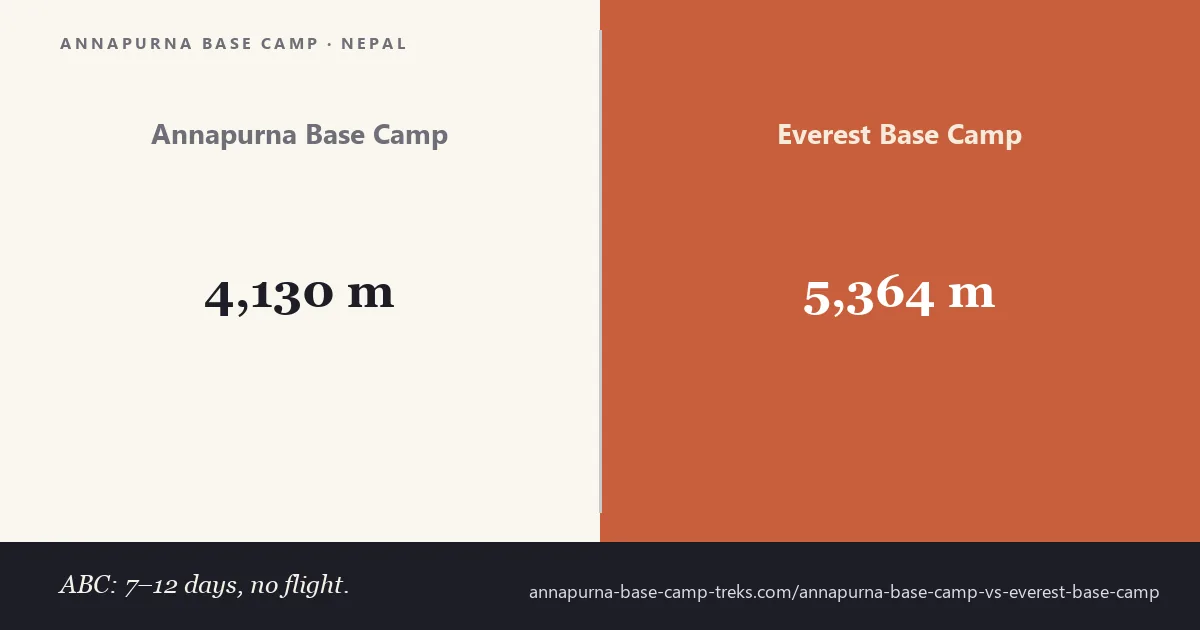
Annapurna Base Camp tops out at 4,130 metres. Everest Base Camp sits at 5,364 metres — more than 1,200 metres higher, and that gap is where most of the difficulty difference lives.
At 4,130 m most trekkers feel thinner air as breathlessness, a mild headache and broken sleep. At 5,364 m the same people are working noticeably harder for every step, sleeping badly for several consecutive nights, and following an itinerary that has to build in dedicated acclimatisation days at Namche Bazaar and Dingboche. Altitude sickness is a real planning constraint on EBC in a way it is a manageable caution on ABC.
If you have never been above 3,000 metres and do not know how your body responds, ABC is the lower-stakes place to find out.
Duration and the Lukla problem
A guided Annapurna Base Camp trek runs roughly seven to twelve days end to end, and the short jeep-assisted routes compress it to five. Everest Base Camp typically needs twelve to sixteen days from Lukla.
Then there is the flight. ABC needs no internal flight at all: you drive from Pokhara to a road head and start walking. EBC starts with a flight to Lukla, one of the most weather-sensitive airstrips in commercial aviation, where closures can delay a departure by a day to three — before you have walked anywhere. The alternative is a multi-day road-and-trail approach that adds a week.
For anyone working around fixed international flights, that difference matters more than the trail statistics.
Cost
Both treks are cheap by international standards and expensive by Nepali ones, but they are not in the same bracket. Budget guided ABC packages start around $425 and most trekkers spend between $500 and $1,200 all in; equivalent EBC budgets start around $1,072 and climb from there, largely because of the Lukla flight, the extra days of guide and porter wages, and the higher lodge and food prices in the Khumbu.
The packages on this site start at $91 for a five-day trek, which sits below those ranges because meals are an add-on rather than included — worth reading alongside the cost and permits guide before comparing headline numbers.
Scenery: a wall, or a circle
This is the part that decides it for a lot of people, and it is more a matter of taste than of quality.
Everest Base Camp is a linear valley walk with the Khumbu’s giants — Ama Dablam, Nuptse, Lhotse — appearing progressively along the way, ending at a glacier moraine from which, famously, you cannot actually see the summit of Everest. The reward is Kala Patthar, the side climb that does deliver the view.
Annapurna Base Camp ends inside the Sanctuary: a near-complete ring of 6,000 m to 8,000 m walls with Annapurna I directly above you and Machhapuchhre — the Fishtail, closed to climbing and still unclimbed — standing at the entrance. You are not looking at the mountains from a distance; you are standing in the middle of them. The approach is also more varied, running from terraced farmland through Gurung villages and rhododendron forest to glacial moraine in the course of a few days, where the Khumbu is drier and starker throughout.
Head to head
| Annapurna Base Camp | Everest Base Camp | |
|---|---|---|
| Maximum altitude | 4,130 m | 5,364 m |
| Typical guided duration | 7–12 days (5 on jeep-assisted routes) | 12–16 days from Lukla |
| Internal flight required | No | Yes — Lukla, weather-dependent |
| Acclimatisation days needed | None built in on most routes | Standard at Namche and Dingboche |
| Typical total budget | ~$500–$1,200 | ~$1,072 and up |
| Landscape | Farmland → forest → glacial cirque | High, dry Khumbu valley |
| Final view | Encircled by the Annapurna massif | Glacier moraine; Kala Patthar for the panorama |
| Permits | ACAP (one permit) | Sagarmatha National Park + Khumbu municipality fee |
Which one should you book?
Choose Annapurna Base Camp if this is your first Himalayan trek, if you have two weeks or less including travel, if altitude worries you, if your budget is the deciding factor, or if you want the trail to change character as you walk it. The seven-day route is the standard recommendation for a first trip; the ten-day Poon Hill route has the gentlest altitude profile of anything on this site.
Choose Everest Base Camp if the name is the point, if you have three weeks and the budget to absorb a Lukla delay, if you have trekked at altitude before and know you handle it, or if you specifically want to stand where the expeditions stage.
And a note worth making: it is not either/or forever. A large share of people who trek ABC come back for EBC later, having learned on the Annapurna trail how their body actually behaves above 4,000 metres. Doing it in that order is a good deal more sensible than the reverse.
Stand at 4,130 m Beneath Annapurna I
The most-booked Annapurna Base Camp trek on GetYourGuide is rated 4.96/5 by 161 travellers. Licensed guide, ACAP permits, guest houses and jeep transfer included. Free cancellation.
Check Availability & Book