Best Time to Trek Annapurna Base Camp
October and April are the strongest months for the Annapurna Base Camp trek. Month-by-month weather, base camp night temperatures, crowds, and when to avoid the monsoon.
There is no closed season on the Annapurna Base Camp trek — the tea houses stay open, the trail stays walkable, and operators run departures year-round. What changes month to month is how much of the mountain you actually get to see, how cold the night at 4,130 metres is, and how many other people are on the staircase in front of you.
Check Availability
The short answer: October or April
If you can pick your dates freely, pick October. It delivers the most stable weather and the clearest mountain views of the year, with the post-monsoon air scrubbed clean and daytime temperatures around 10–15 °C at base camp. The cost is company: October is the busiest month on the trail, and the tea houses above Chhomrong fill up.
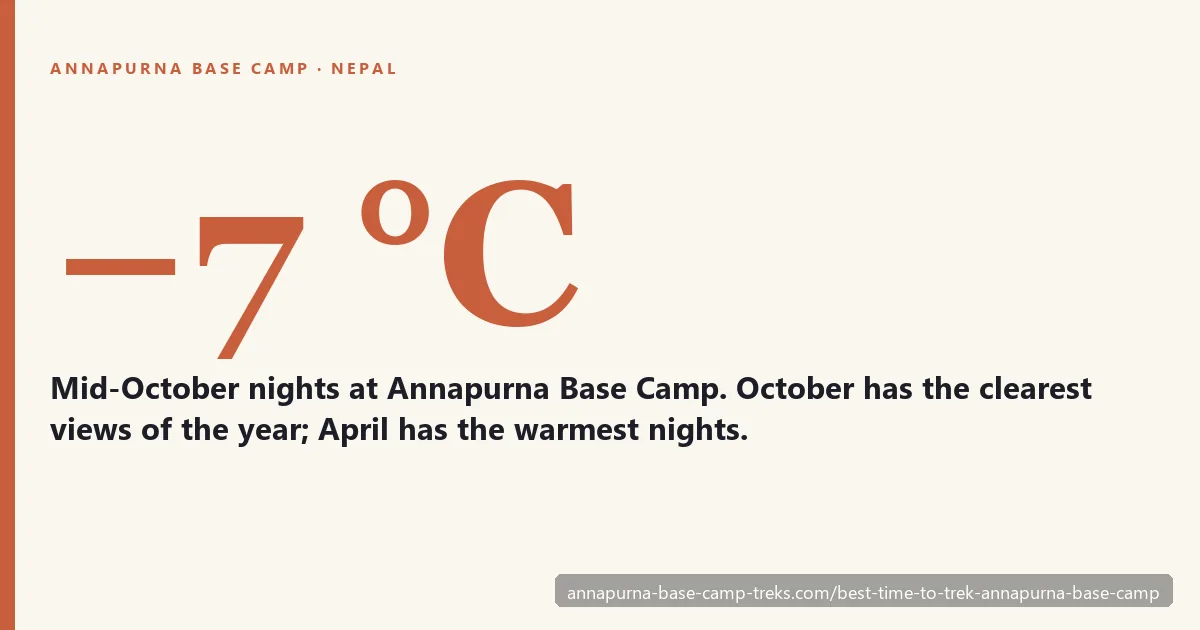
April is the second choice and the one many returning trekkers prefer. The rhododendron forests between Ghandruk and Deurali come into bloom — the reason so many Annapurna photographs are full of red and pink — and the nights are warmer, sitting around −2 °C to −4 °C at base camp instead of October’s −7 °C.
Both months are firmly inside the two trekking seasons that Nepal’s calendar is built around: post-monsoon autumn (October–November) and pre-monsoon spring (March–April).
Month by month
October — clearest views, most people
The benchmark month. The monsoon has washed the haze out of the air and the peaks stand out sharply from Poon Hill and from the Sanctuary floor. Rain is minimal. The trade-off is crowding: expect queues on the Chhomrong staircase in the mornings and to book your lodge bed through your guide rather than turning up. Base camp nights in mid-October regularly drop to around −7 °C.
November — driest month, thinning crowds
November has the least rainfall of the autumn season and the most reliable sunshine. The first half is still busy; the second half — roughly 15 to 30 November — is a genuine shoulder-season sweet spot, with reduced crowds and views that are still strong. It is also colder: base camp nights are reported down around −10 °C, which makes your sleeping bag rating a real decision rather than a detail. If your bag is rated to 0 °C, add a liner.
December to February — cold, quiet, snow-dependent
The trail stays open and the views on a clear winter day are exceptional, but snow can close the section above Deurali and avalanche risk in the upper gorge is a real consideration that your guide will assess on the day. Lodges thin out, some close. This is a season for trekkers who want emptiness and are properly equipped for it, not for a first Himalayan trip.
March — cold start, warming end
Generally dry, with the first half still carrying winter’s cold and the second half warming noticeably. High-altitude nights can still fall very low. Early March, like late November, is a shoulder-season window: fewer people, workable weather, strong views.
April — rhododendrons and warm nights
The most colourful month on the trail and the warmest of the two main seasons at night. Clear skies and lengthening days. Slightly hazier than October — the pre-monsoon atmosphere carries more dust — but the forest sections are at their best, and the temperature difference at base camp is the one most first-time trekkers actually feel.
May — hot below, hazy above
Warm and pleasant in the lower valleys, but haze builds through the month and the monsoon starts pushing in from the end of May. Still workable, particularly early in the month.
June to August — monsoon
Rain is heavy and erratic, cloud often sits on the Sanctuary all day, and leeches appear on the wet lower forest trails below Bamboo. Long trousers tucked into gaiters plus insect repellent keeps them off. Treks do run and people do get lucky — one traveller on a five-day monsoon departure reported good views across the trip, “even if some were cloudy” — but you are gambling with the main reason you came.
September — the turn
The monsoon recedes through the month. Early September is still wet; late September can be superb, with the crowds not yet arrived. It is the most volatile month to plan around and the one where a spare day in the itinerary earns its keep.
What the season changes about your kit
The single item that varies most with the month is your sleeping bag. Tea-house rooms above Deurali are unheated in every season — the dining-room stove is the warm place — so the night temperature at base camp is what you are actually sleeping in. A bag rated to 0 °C is adequate in April; it is not adequate in late November or winter.
The rest is season-independent: broken-in boots, a waterproof shell, warm layers, sunglasses and sunscreen for the exposed moraine, and cash in Nepali rupees, since there are no ATMs above Pokhara.
How the season interacts with your route choice
The shorter the trek, the more a single cloudy morning costs you. On a five-day route you have exactly one sunrise at base camp; if it is socked in, that is the trip. A seven-day or ten-day itinerary has slack in it — a guide can hold a day or shift a stage. In the shoulder months, and especially in September, that flexibility is worth more than the price difference between packages.
If you are still choosing between routes, the difficulty guide covers what each schedule asks of you physically, and the cost and permits guide covers what each one actually includes.
Stand at 4,130 m Beneath Annapurna I
The most-booked Annapurna Base Camp trek on GetYourGuide is rated 4.96/5 by 161 travellers. Licensed guide, ACAP permits, guest houses and jeep transfer included. Free cancellation.
Check Availability & Book